



In today's complex threat landscape, a strong perimeter is no longer enough. The real test of security lies within your network's internal defenses, where a single compromised device could otherwise grant an attacker full access to your most critical assets. Effective network segmentation creates secure, isolated zones within your infrastructure, containing potential breaches and preventing attackers from moving laterally. This strategy is essential for protecting sensitive data, ensuring operational continuity, and meeting stringent compliance mandates like HIPAA, PCI DSS, and CMMC.
For small and midsize businesses, particularly those in regulated sectors like healthcare and finance, implementing robust internal controls is not just a recommendation, it's a foundational security requirement. A well-segmented network architecture drastically reduces your attack surface, limits the impact of a security incident, and simplifies the process of demonstrating compliance to auditors. It transforms your network from a flat, open field into a compartmentalized fortress where each segment has its own defenses.
This guide moves beyond theory, offering a prioritized roundup of 10 actionable network segmentation best practices you can implement to build a resilient and secure network. We will explore a range of powerful techniques, from foundational VLANs and firewall rules to advanced microsegmentation and Zero Trust principles. Each item provides the practical steps and specific insights needed to turn security concepts into tangible, effective protection for your organization’s most valuable information.
1. Zero Trust Architecture Implementation
The traditional "castle-and-moat" security model, which trusts anyone inside the network perimeter, is dangerously outdated. A Zero Trust Architecture (ZTA) fundamentally inverts this by operating on the principle of "never trust, always verify." This model assumes that threats exist both outside and inside the network, so no user or device is granted automatic trust. Access is a privilege, not a right.
Implementing ZTA is a cornerstone of modern network segmentation best practices because it forces organizations to meticulously define and enforce access on a per-request basis. Instead of just creating large, trusted zones, Zero Trust pushes for micro-perimeters around individual applications or data sets. Every access request is rigorously authenticated and authorized, regardless of where it originates. This dramatically reduces the attack surface and prevents lateral movement by containing breaches to the smallest possible segment.
How to Implement a Zero Trust Model
Getting started with Zero Trust doesn't require a complete overhaul overnight. A phased approach is most effective for small and midsize businesses.
- Establish Strong Identity: Begin with robust Identity and Access Management (IAM). Implement Multi-Factor Authentication (MFA) everywhere possible. This is your foundation.
- Create an Asset Inventory: You cannot protect what you don't know you have. Develop a comprehensive inventory of all devices, applications, and data stores.
- Implement Microsegmentation: Use software-defined networking, next-generation firewalls, or specialized tools to create granular segments around critical assets. For example, a healthcare practice could create a microsegment just for its Electronic Health Record (EHR) system, completely isolating it from guest Wi-Fi and administrative workstations.
- Enforce Principle of Least Privilege: Grant users and systems the minimum level of access necessary to perform their functions. A user in the finance department should not have access to developer servers.
- Continuously Monitor and Validate: Deploy tools to continuously monitor network traffic and user behavior. A ZTA model requires constant validation to detect and respond to threats in real time.
This proactive stance is critical for today's complex environments, reinforcing the importance of cybersecurity for growing businesses that handle sensitive data or must meet compliance standards like HIPAA or PCI DSS.
2. VLAN-Based Segmentation
A foundational and highly effective method for dividing a network is through Virtual Local Area Networks (VLANs). VLANs logically group devices together into separate broadcast domains, even if they are connected to the same physical switch. This allows network administrators to partition their network based on function, department, or security requirements without needing costly physical infrastructure changes.
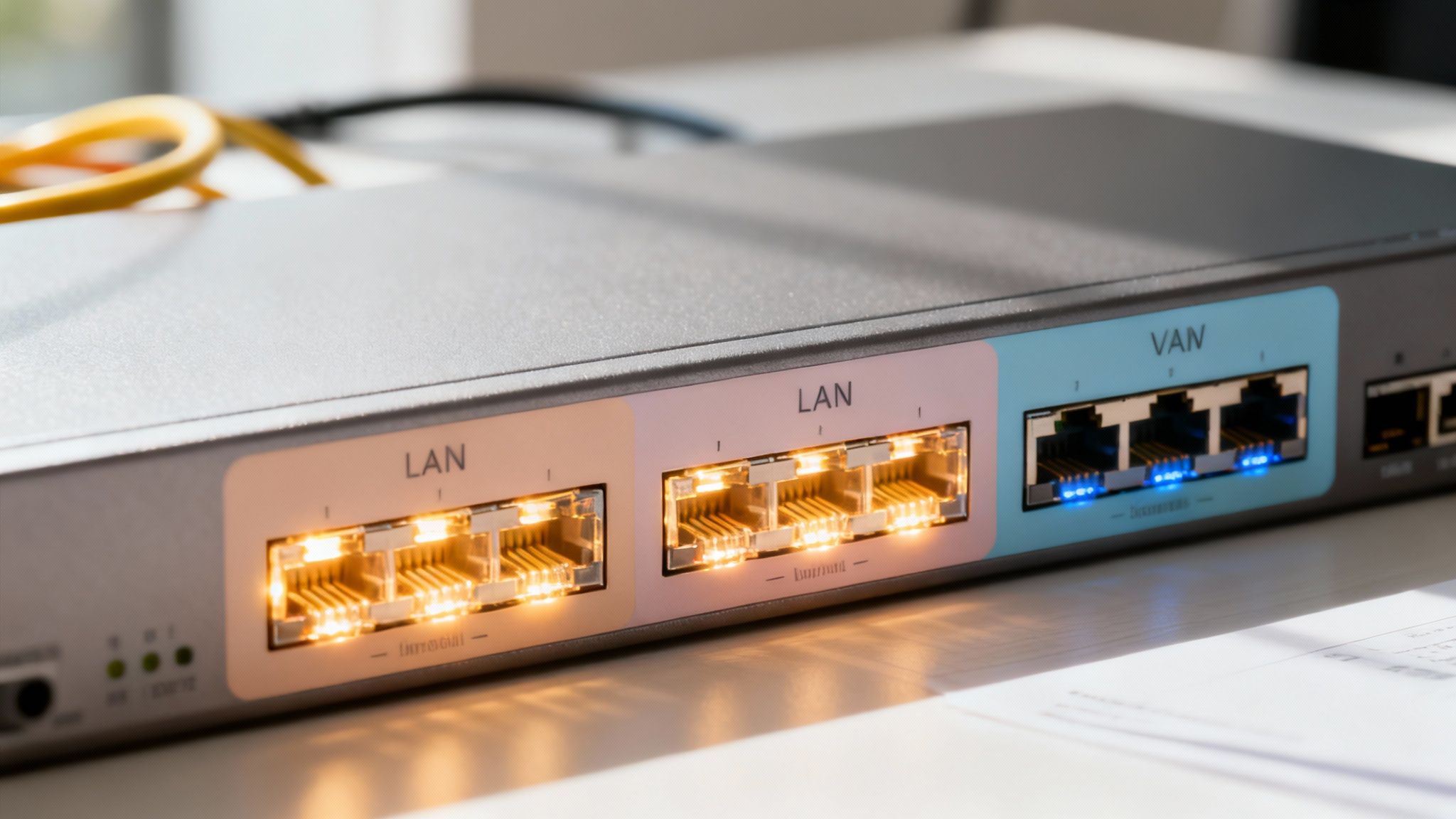
This Layer 2 segmentation is a core component of network segmentation best practices because it directly controls traffic flow. By default, devices in one VLAN cannot communicate with devices in another. Communication between VLANs must be explicitly permitted and routed through a Layer 3 device, like a router or a multilayer switch, where access control policies can be enforced. This creates critical choke points for monitoring and securing inter-segment traffic, containing potential threats and limiting an attacker's ability to move laterally across the network.
How to Implement VLAN-Based Segmentation
Properly implementing VLANs is a powerful step toward a more secure and manageable network architecture. It enhances performance by reducing broadcast traffic and provides a clear security boundary.
- Group by Function or Trust Level: Segment devices logically. For instance, a healthcare clinic could create separate VLANs for medical devices (EHR systems), administrative staff, guest Wi-Fi, and VoIP phones. This ensures that a compromised guest device cannot access sensitive patient records.
- Use Access Control Lists (ACLs): Implement ACLs on your router or Layer 3 switch to strictly define what traffic is allowed between VLANs. Deny all traffic by default and only permit necessary communication, adhering to the principle of least privilege.
- Implement 802.1X Authentication: For enhanced security, use IEEE 802.1X for port-based network access control. This protocol can dynamically assign devices to the correct VLAN upon successful authentication, preventing unauthorized devices from connecting to sensitive network segments.
- Establish Naming Conventions and Documentation: Maintain clarity and simplify management by using a consistent naming convention for your VLANs (e.g., "VLAN10_Admin," "VLAN20_Guest"). Keep detailed documentation of your VLAN topology, including IP ranges, assigned ports, and ACL rules.
- Monitor Inter-VLAN Traffic: Regularly monitor and log the traffic that crosses between your VLANs. This is crucial for identifying unauthorized access attempts, policy violations, or unusual behavior that could indicate a security incident.
3. Microsegmentation with Software-Defined Networking (SDN)
While traditional segmentation creates large zones with firewalls, microsegmentation takes a far more granular approach. It uses the power of Software-Defined Networking (SDN) to create secure zones for individual workloads or applications. This essentially wraps each critical component in its own security perimeter, drastically limiting an attacker's ability to move laterally across the network if a breach occurs.

This method is one of the most effective network segmentation best practices because policies are not tied to physical hardware like switches. Instead, security controls are applied via software, allowing them to follow workloads dynamically, whether they are on-premises, in the cloud, or in a hybrid environment. For regulated industries, this provides a powerful way to isolate systems that process sensitive data, such as a patient portal in a healthcare network or a payment processing application in a financial firm, ensuring they are completely walled off from less secure segments.
How to Implement Microsegmentation with SDN
Successfully deploying microsegmentation requires a strategic, application-centric approach rather than just a network-centric one.
- Map Application Dependencies: Before creating any policies, you must understand how your applications communicate. Use network traffic analysis and visualization tools to map all legitimate communication paths between workloads.
- Start with a Test Environment: Implement and test your segmentation policies in a non-production or development environment first. This allows you to identify and fix any rules that might accidentally block critical application traffic without impacting business operations. When designing your network with microsegmentation in mind, especially consider how it aligns with modern microservices architecture best practices for enhanced security and resilience.
- Establish Clear Tagging Standards: Use consistent and descriptive tags for workloads, applications, and environments (e.g., "production-EHR," "dev-billing," "pci-scope"). This makes policy creation and management far more intuitive and scalable.
- Implement Comprehensive Logging: Enable detailed logging for all traffic flows, especially for traffic that is denied by your policies. This data is invaluable for troubleshooting, security incident analysis, and demonstrating compliance to auditors.
4. DMZ (Demilitarized Zone) Architecture
A Demilitarized Zone (DMZ) is a fundamental concept in network security that establishes a buffer between your trusted internal network and the untrusted internet. This physical or logical subnetwork contains and exposes an organization's external-facing services, such as web, email, and DNS servers. By isolating these services, you create a controlled environment that significantly limits the exposure of your critical internal systems to external threats.
The DMZ is a crucial component of network segmentation best practices because it acts as a sacrificial layer. If an attacker compromises a server within the DMZ, they are still firewalled off from gaining access to the sensitive data and core infrastructure residing on the internal LAN. This layered defense is essential for any organization, from a healthcare system protecting patient portals to an e-commerce platform processing customer transactions, as it contains potential breaches at the perimeter.
How to Implement a DMZ
Setting up a DMZ requires careful planning and strict firewall rule sets to ensure it functions as an effective security barrier.
- Deploy a Two-Firewall Setup: The most secure DMZ design uses two firewalls. The first firewall, facing the internet, allows traffic only to the DMZ. The second firewall, between the DMZ and your internal network, strictly controls and limits any communication originating from the DMZ.
- Enforce "Default Deny" Policies: Configure both firewalls with a "default deny" rule. This means that no traffic is allowed unless it is explicitly permitted. For example, only allow HTTPS traffic (port 443) from the internet to your web server in the DMZ.
- Harden All DMZ Systems: Servers and devices within the DMZ must be securely configured and hardened. This includes removing unnecessary services, applying patches promptly, and implementing host-based intrusion detection systems (IDS).
- Prohibit Direct Internal Communication: A critical rule is that systems within the DMZ should never be allowed to initiate connections to systems on the internal network. Communication should only flow from the internal network to the DMZ or from the internet to the DMZ.
- Monitor and Log Relentlessly: Continuously monitor all traffic entering, leaving, and within the DMZ. Maintain separate and secure logging for all DMZ events to detect and investigate anomalous activity or potential security incidents.
5. Role-Based Access Control (RBAC) for Network Resources
Managing access permissions on an individual basis is inefficient and prone to error, especially as a business grows. Role-Based Access Control (RBAC) solves this by assigning network access permissions based on a user's or device's predefined role within the organization. Instead of managing hundreds of individual permissions, you manage a handful of roles, such as 'Developer,' 'Clinical Staff,' or 'Finance.'
RBAC is a powerful tool in your arsenal of network segmentation best practices because it directly links business functions to network policies. It ensures that all members of a specific role have consistent and appropriate access, reinforcing the principle of least privilege. When an employee changes roles, an administrator simply reassigns them to a new role, and their network access rights automatically update. This systematic approach simplifies administration, strengthens security, and makes compliance auditing far more straightforward.
How to Implement RBAC for Segmentation
Integrating RBAC into your network segmentation strategy requires a clear understanding of your organization's structure and operational needs. A methodical rollout is key to its success.
- Define and Document Roles: Begin by conducting a thorough analysis of job functions. Work with department heads to identify the specific data, applications, and network resources each job category requires. For a financial firm, this could mean defining 'Trader,' 'Compliance Officer,' and 'Operations' roles with distinct access policies.
- Map Roles to Network Segments: Assign each defined role to specific network segments or VLANs. For instance, the 'Clinical Staff' role in a healthcare practice would be granted access to the Electronic Health Record (EHR) segment but restricted from the financial systems segment.
- Integrate with IAM Systems: Leverage an Identity and Access Management (IAM) solution like Microsoft Entra ID or Okta. These platforms centralize role management and can enforce RBAC policies across your firewalls, switches, and applications.
- Create Role-Based Firewall Rules: Configure your firewalls with rules that reference user roles or groups instead of individual IP addresses. This allows a 'Developer' to access a staging server from any device on the corporate network, while a 'Sales' user cannot.
- Establish a Review Process: Roles and their associated permissions are not static. Implement a quarterly audit process to review all roles, their members, and their access rights to ensure they remain appropriate and address any changes in business functions.
6. Network Access Control (NAC) Implementation
Simply creating network segments is not enough; you must also control what devices can access them. Network Access Control (NAC) acts as a digital gatekeeper, enforcing security policies by authenticating and authorizing devices before they are granted access. It goes beyond simple user credentials by inspecting the device itself for compliance, ensuring it meets predefined security standards.
Implementing NAC is a critical component of network segmentation best practices because it automates policy enforcement at the point of entry. It can verify a device's patch level, antivirus status, and firewall configuration, then dynamically assign it to the appropriate VLAN or segment. This prevents non-compliant or unknown devices from ever touching sensitive network areas, effectively stopping potential threats at the door.
How to Implement Network Access Control (NAC)
A gradual rollout is the key to a successful NAC deployment, allowing your organization to fine-tune policies without disrupting business operations.
- Start with Basic Compliance Checks: Begin by implementing foundational checks, such as verifying that all connecting devices have an up-to-date antivirus client and the latest operating system patches.
- Establish Clear Remediation Workflows: When a device fails a compliance check, don't just block it. Create an automated workflow that directs the user to a remediation portal with clear instructions on how to become compliant.
- Use Conditional Access: Differentiate policies based on context. For example, a corporate-owned laptop might be granted full access, while a personal device connecting via a BYOD program is placed in a more restricted segment with limited application access.
- Implement Grace Periods: When rolling out a new policy, provide a grace period. This allows users time to update their devices before access is restricted, minimizing helpdesk tickets and frustration.
- Maintain Detailed Audit Logs: NAC systems generate valuable data. Use these logs to monitor access attempts, track compliance trends, and provide detailed evidence for regulatory audits like HIPAA or PCI DSS.
A well-configured NAC solution is essential for managing the diverse array of devices in modern networks. To ensure your deployment aligns with your security goals, you may need expert assistance; learn more about the cybersecurity services that can help fortify your network perimeter.
7. Application-Layer Segmentation and Firewalls
Traditional firewalls that operate on ports and IP addresses are no longer sufficient to secure modern networks. Application-layer segmentation provides a far more intelligent and granular level of control by inspecting traffic based on the actual application generating it, such as Microsoft 365 or Salesforce, rather than just the port it uses (like port 443 for HTTPS). This approach is a critical evolution in network segmentation best practices.
By leveraging Next-Generation Firewalls (NGFWs) or Web Application Firewalls (WAFs), organizations can differentiate between legitimate business applications and unauthorized or malicious ones, even if they use the same port. This allows security teams to create policies that permit specific application functions while blocking others. For instance, you could allow access to a corporate social media account but block the use of its integrated chat feature, thereby minimizing risk without hindering productivity.
How to Implement Application-Layer Segmentation
This method provides deep visibility and control, but requires careful planning to be effective. A well-configured NGFW can become a central pillar of your security architecture.
- Gain Application Visibility: Start by using your NGFW in a monitoring-only mode. Use its application visibility dashboards to identify all applications traversing your network, including unsanctioned "shadow IT" services.
- Establish Baseline Profiles: Analyze the collected data to create a baseline of normal application usage. Understand which departments use which applications and for what purpose. This baseline is essential for spotting anomalies later.
- Develop Granular Policies: Move beyond simple allow/deny rules based on IP addresses. Create policies based on application identity and user roles. For example, a financial services firm could use a Fortinet FortiGate to allow its accounting team access to a specific financial SaaS platform while blocking all other departments.
- Leverage Threat Intelligence: Integrate your firewall with threat intelligence feeds. These services provide real-time updates on malicious applications and IPs, allowing your firewall to proactively block emerging threats without manual intervention.
- Test Before Enforcing: Always deploy new application control policies in a non-blocking or "shadow" mode first. This allows you to verify that the policy doesn't accidentally disrupt legitimate business operations before you fully enforce it.
8. Secure Remote Access and VPN Segmentation
The rise of remote and hybrid work models has stretched the network perimeter to every home office, coffee shop, and hotel room. Simply providing a VPN is not enough; without proper segmentation, a single compromised remote device can become a gateway into your entire internal network. Securing remote access requires isolating these connections into their own controlled segments, ensuring they only touch the specific resources they are authorized to access.
This practice is a critical component of modern network segmentation best practices because it treats remote access as an inherently untrusted connection. Instead of connecting users directly to the main corporate network, a dedicated VPN segment acts as a secure antechamber. From this isolated zone, access to other network segments is strictly governed by firewall rules and access control policies, drastically limiting the potential blast radius of a remote breach and preventing lateral movement from an external entry point.
How to Implement Secure VPN Segmentation
A properly segmented remote access strategy ensures that convenience does not compromise security. It involves layering controls to verify both the user and their device.
- Create a Dedicated VPN Zone: Use a firewall or VLAN to create a separate network segment exclusively for remote access users. This zone should have no default access to other internal networks.
- Enforce Strong Authentication: Mandate Multi-Factor Authentication (MFA) for all VPN connections. This is a non-negotiable first line of defense against compromised credentials.
- Implement Conditional Access Policies: Use solutions like Cisco AnyConnect with Duo or Palo Alto Networks GlobalProtect to verify the security posture of the connecting device. Check for up-to-date antivirus, disk encryption, and operating system patches before granting any access.
- Apply Granular Access Controls: Create different VPN profiles for different user roles (e.g., developers, finance, third-party contractors). Each profile should only have firewall rules allowing access to the specific applications and servers required for that role, adhering to the principle of least privilege.
- Monitor Remote Access Traffic: Actively monitor traffic originating from the VPN segment for unusual behavior, such as large data transfers or attempts to scan other network segments. This helps detect and respond to potential intrusions in real time.
9. Container and Kubernetes Network Policies
As organizations adopt containerization, traditional network segmentation methods become insufficient. Container and Kubernetes network policies address this by providing fine-grained control over traffic flow at the application level. These policies operate within a Kubernetes cluster, defining which pods can communicate with each other and with external services, effectively creating microsegments around individual microservices.
This approach is a critical component of modern network segmentation best practices because it moves security enforcement closer to the workload itself. Instead of relying solely on perimeter firewalls or VLANs, network policies ensure that even if one container is compromised, it cannot freely communicate with others. This containment capability is essential for preventing lateral movement within a dynamic, containerized environment and enforcing a Zero Trust model at the pod level.
How to Implement Kubernetes Network Policies
Implementing network policies requires a CNI (Container Network Interface) plugin that supports them, such as Calico or Cilium. Once your environment is ready, you can apply policies incrementally.
- Start with a Default Deny Policy: Begin by applying a default policy that denies all ingress and egress traffic to a specific namespace. This creates a secure baseline, forcing you to explicitly allow required communication paths.
- Use Descriptive Labels: Apply clear and consistent labels to your pods, such as
app: backendorrole: database. Network policies use these labels as selectors to target specific workloads, making your rules readable and maintainable. - Implement Incrementally: Introduce policies one application or service at a time. Start with non-critical workloads to test and validate your rules before applying them to production systems. For instance, allow traffic from your
app: frontendpods to yourapp: backendpods on a specific port. - Monitor and Test Policies: Use tools to visualize traffic flow and monitor for policy violations. Simulating network conditions can help identify misconfigurations before they impact users. For advanced segmentation within containerized environments, understanding robust security measures is crucial, including a deep dive into Kubernetes security best practices.
- Leverage Service Mesh: For even greater control and visibility, consider a service mesh like Istio, which can enforce mutual TLS (mTLS) between services, providing encrypted communication and strong identity verification.
10. Continuous Monitoring and Segmentation Validation
Implementing network segmentation is not a "set it and forget it" task. Its effectiveness degrades over time as networks evolve, new applications are deployed, and firewall rules become outdated. Continuous monitoring and validation ensure that your segmentation controls remain robust and function exactly as intended, turning a static defense into a dynamic, responsive security posture.
This practice is essential for maintaining the integrity of your network segmentation best practices because it provides the necessary feedback loop. By actively monitoring traffic flows and testing security rules, you can verify that segments are truly isolated and that access policies are being enforced. This process helps detect unauthorized communication attempts, identify misconfigurations, and confirm that your segmentation strategy effectively limits an attacker's ability to move laterally across the network.

How to Implement Continuous Monitoring and Validation
For small and midsize businesses, effective monitoring can be achieved by combining automated tools with disciplined processes. The goal is to gain visibility and validate controls without creating overwhelming operational overhead.
- Establish a Baseline: First, map and understand normal, approved traffic patterns between your segments. Use tools like Splunk, Datadog, or the ELK Stack to create a baseline of what is considered legitimate communication.
- Implement Intrusion Detection Systems (IDS): Deploy an IDS like Suricata to monitor traffic for policy violations. For example, a financial services firm can set a rule to immediately alert if a workstation in the customer service segment attempts to connect to a database server in the trading platform segment.
- Conduct Regular Security Assessments: Schedule quarterly or biannual segmentation penetration tests or red team exercises. These simulated attacks are designed to find and exploit weaknesses in your segmentation boundaries, providing invaluable real-world validation.
- Define Clear Alerting and Response: Create clear thresholds for alerts and establish automated playbooks for common violations, such as blocking a source IP that repeatedly violates a firewall rule. This ensures a swift and consistent response to potential threats.
- Document and Review Exceptions: Meticulously document any necessary exceptions to your segmentation policies, including the business justification and an expiration date. Review these exceptions regularly to ensure they are still required.
This ongoing vigilance is critical for any organization, especially those handling sensitive data or facing compliance mandates. For businesses seeking to offload this complex responsibility, exploring the benefits of managed IT and cybersecurity services can provide the expert oversight needed to maintain a secure and validated network.
Network Segmentation Best-Practices: 10-Item Comparison
| Approach | Implementation Complexity 🔄 | Resource Requirements ⚡ | Expected Outcomes 📊⭐ | Key Advantages ⭐ | Ideal Use Cases 💡 |
|---|---|---|---|---|---|
| Zero Trust Architecture Implementation | Very high — org‑wide IAM, MFA, monitoring 🔄🔄🔄 | High — identity platforms, analytics, modernization ⚡⚡⚡ | Strongly reduces lateral movement; continuous verification 📊⭐⭐⭐ | Minimizes breach impact; least‑privilege enforcement | Large enterprises, remote/hybrid work, high‑risk data |
| VLAN-Based Segmentation | Low–Medium — switch config & planning 🔄🔄 | Low — existing networking gear, modest ops ⚡ | Logical Layer‑2 isolation; improved performance 📊⭐ | Cost‑effective; widely supported technology ⭐ | SMBs, departmental separation, campus networks |
| Microsegmentation with SDN | High — controller & policy design; skills required 🔄🔄🔄 | High — SDN platform, orchestration, trained staff ⚡⚡⚡ | Granular workload isolation; faster containment 📊⭐⭐ | Workload‑level control; dynamic policy enforcement ⭐ | Data centers, cloud environments, compliance zones |
| DMZ (Demilitarized Zone) Architecture | Medium — multi‑layer firewalls and routing 🔄🔄 | Medium — firewalls, IDS/IPS, bastion hosts ⚡⚡ | Isolates external services; reduces direct exposure 📊⭐ | Proven buffer for public‑facing services; simpler audits ⭐ | Web servers, mail/DNS public services, PCI/HIPAA contexts |
| Role‑Based Access Control (RBAC) | Medium — role modeling and governance 🔄🔄 | Low–Medium — IAM tools, audit processes ⚡⚡ | Consistent access policies; easier auditing 📊⭐ | Scalable permission management; least‑privilege support ⭐ | Organizations with clear job functions; compliance needs |
| Network Access Control (NAC) Implementation | Medium–High — infrastructure integration & policies 🔄🔄🔄 | Medium — NAC appliances, endpoint checks, remediation ⚡⚡⚡ | Blocks non‑compliant devices; improved visibility 📊⭐⭐ | Automates device posture checks; BYOD control ⭐ | Campuses, enterprises with many endpoints, guest networks |
| Application‑Layer Segmentation & Firewalls | High — DPI, SSL inspection, policy tuning 🔄🔄🔄 | High — NGFW/WAF hardware or cloud, compute ⚡⚡⚡ | Detects sophisticated app threats; fine app control 📊⭐⭐ | Content‑aware protection; reduces blind spots ⭐ | Protecting web apps, blocking shadow IT, financial apps |
| Secure Remote Access & VPN Segmentation | Medium — auth, conditional access, scaling 🔄🔄 | Medium — VPN/SSO, MFA, monitoring ⚡⚡ | Secure remote sessions; conditional connectivity 📊⭐ | Enables secure hybrid work; per‑app access control ⭐ | Remote workers, contractors, distributed teams |
| Container & Kubernetes Network Policies | Medium–High — Kubernetes/networking expertise 🔄🔄🔄 | Low–Medium — CNI plugins, policy controllers ⚡⚡ | Pod‑level isolation; limits lateral container movement 📊⭐⭐ | Cloud‑native microsegmentation; label‑based policies ⭐ | Kubernetes clusters, microservices, cloud‑native apps |
| Continuous Monitoring & Segmentation Validation | Medium — monitoring pipelines & analyst ops 🔄🔄 | High — SIEM/XDR, analytics, skilled analysts ⚡⚡⚡ | Detects policy failures; validates segmentation efficacy 📊⭐⭐⭐ | Identifies gaps early; enables rapid incident response ⭐ | Any organization with segmentation; high‑security programs |
From Blueprint to Reality: Your Next Steps in Network Segmentation
We've explored a comprehensive array of network segmentation best practices, from foundational VLAN strategies and DMZ architectures to the granular control offered by microsegmentation and container policies. The journey from a flat, vulnerable network to a resilient, segmented environment is not a sprint; it's a strategic marathon built on careful planning, incremental implementation, and continuous validation. The principles discussed, including Zero Trust alignment, Role-Based Access Control (RBAC), and continuous monitoring, are not just isolated tactics. They are interconnected components of a modern, defense-in-depth security posture.
Implementing these practices transforms your network from a single, high-risk domain into a series of well-defended, independent zones. This architectural shift dramatically reduces your attack surface, contains breaches before they can propagate, and simplifies the process of achieving and maintaining regulatory compliance, whether for HIPAA, PCI DSS, or CMMC requirements.
Key Takeaways for Immediate Action
To transition from understanding these concepts to implementing them, focus on these critical takeaways:
- Start with Your Crown Jewels: Don't try to segment everything at once. Begin by identifying your most critical assets: patient data, financial records, intellectual property, or essential operational systems. Build your first segments around these high-value targets to achieve the most significant security impact quickly.
- Embrace the Principle of Least Privilege: This is the golden rule that underpins effective segmentation. Every user, device, and application should only have the absolute minimum level of access required to perform its function. This simple yet powerful principle should guide every firewall rule and access policy you create.
- Segmentation is a Living Strategy: Your business is not static, and neither is your network. New applications are deployed, employees change roles, and compliance mandates evolve. Your segmentation strategy must be a dynamic process, with regular reviews, testing, and policy updates to ensure it remains effective against new threats and aligned with business needs.
Your Actionable Next Steps
Feeling overwhelmed is a common reaction to the depth of network security. The key is to start small and build momentum. Here is a practical, step-by-step plan to begin your journey:
- Conduct a Network Discovery and Asset Inventory: You cannot protect what you do not know you have. Use network scanning tools to create a complete inventory of all connected devices, applications, and data flows. This map is the foundational blueprint for your segmentation plan.
- Define Your Segmentation Goals: Are you primarily focused on CMMC compliance, protecting sensitive patient data under HIPAA, or isolating a critical point-of-sale system for PCI DSS? Clearly define your objectives to guide your strategy and measure success.
- Develop a Phased Implementation Roadmap: Based on your asset inventory and goals, create a phased rollout plan. Phase one might involve creating a dedicated VLAN for IoT devices or building a secure DMZ for public-facing servers. Subsequent phases can tackle more complex tasks like microsegmenting your critical application environments.
- Validate and Test Relentlessly: After implementing each new segment, use vulnerability scanners and penetration testing techniques to validate your controls. Ensure that firewall rules are working as intended and that traffic cannot move between zones in unauthorized ways.
Mastering these network segmentation best practices is one of the most impactful investments you can make in your organization's cybersecurity resilience. It is the architectural foundation that makes other security controls more effective and provides a powerful defense against the lateral movement that characterizes so many of today’s devastating cyberattacks. By taking a methodical, asset-focused, and iterative approach, you can build a network that not only withstands threats but also serves as a secure platform for business growth and innovation.
Navigating the complexities of network segmentation, from initial design to ongoing management, requires specialized expertise. The veteran-owned team at Defend IT Services provides the hands-on cybersecurity and managed IT support that San Antonio businesses trust to implement these best practices correctly. Let us help you build a secure, compliant, and resilient network architecture by visiting Defend IT Services to schedule a consultation.