
If you're part of the defense industrial base, you've undoubtedly heard about the Cybersecurity Maturity Model Certification, or CMMC. In simple terms, it's a unified standard the Department of Defense (DoD) rolled out to make sure its entire supply chain is secure. It's a verification process to prove that defense contractors and their subcontractors have the right cybersecurity controls in place to protect sensitive government information on their networks.
What CMMC Is and Why It Matters for Your Business
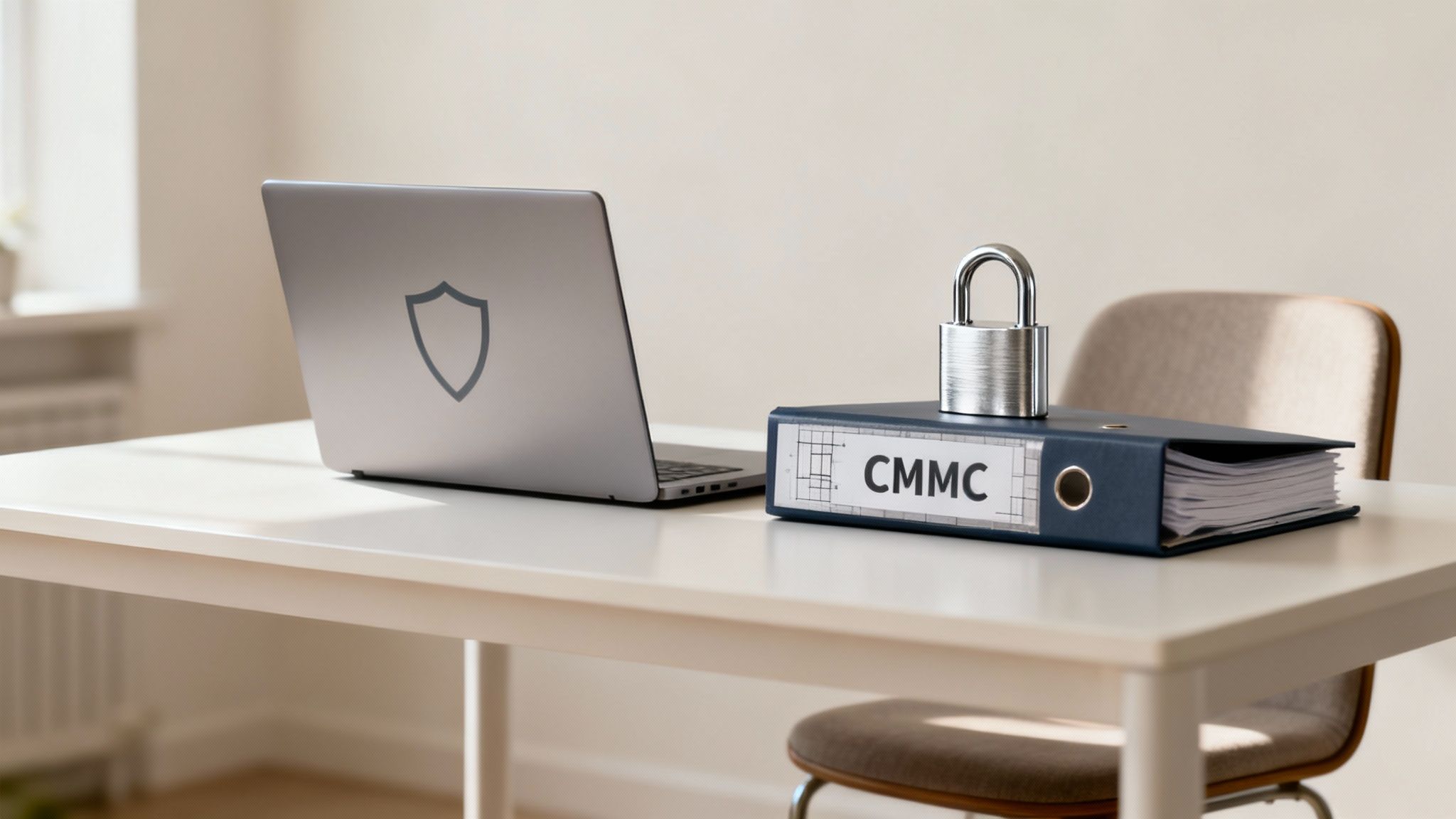
Think of CMMC like a mandatory building code for cybersecurity. Just as a new building has to pass inspections to prove it's safe for people, your business must meet specific digital protection standards to prove it can safely handle government data. The level of "inspection" you need depends entirely on how sensitive that data is.
This framework is a huge departure from the old way of doing things. For years, the defense industry relied on a trust-based model where companies simply self-certified that they were following cybersecurity best practices. But as cyber threats became more sophisticated and frequent, that was no longer good enough. CMMC was created to close this gap by switching to a verified system where compliance isn't just claimed—it's proven through an audit.
The Shift from Trust to Verification
The official effective date for the CMMC program is November 10, 2025, which marks a major turning point for every defense contractor. The program lays out specific cybersecurity standards for any company that handles sensitive unclassified information, requiring them to get certified at one of three maturity levels.
This move from trust to verification means that just having security policies written down in a binder isn't enough anymore. Organizations now have to show real, tangible proof that their security controls are actually working and being managed effectively. For any business in the DoD supply chain, CMMC compliance is non-negotiable; it's the ticket to play for winning and keeping contracts.
CMMC elevates cybersecurity from a back-office IT task to a core business function. It places the protection of sensitive data on the same level as financial accountability and quality control, making it a prerequisite for doing business with the DoD.
Core Goals of the CMMC Program
The program was designed with a few key goals in mind, all aimed at bolstering national security and protecting the supply chain.
- Standardize Cybersecurity: CMMC establishes a single, consistent set of cybersecurity rules across the entire Defense Industrial Base (DIB). No more guesswork.
- Verify Implementation: It forces contractors to move beyond documenting security controls to actively implementing and maintaining them day in and day out.
- Protect Sensitive Information: The ultimate objective is to shield Federal Contract Information (FCI) and Controlled Unclassified Information (CUI) from falling into the wrong hands.
- Build a Resilient Supply Chain: By holding every contractor to a verified standard, the framework strengthens the security of the entire defense ecosystem. A critical part of this is ensuring businesses can securely distribute information to regulatory authorities.
At the end of the day, CMMC compliance is a business necessity. It’s how you demonstrate a real commitment to protecting national security, which can set you apart in a crowded market. Getting ready for this certification starts with a clear-eyed assessment of your current security posture, a process we dive into in our guide on why San Antonio businesses need managed IT and cybersecurity services.
Unpacking the Three CMMC 2.0 Levels
The CMMC framework isn’t a one-size-fits-all checklist. It’s a tiered system that smartly matches the level of cybersecurity required to the sensitivity of the information you handle. Think of it like this: a local public library doesn't need the same Fort Knox-level security as a federal gold reserve. CMMC applies that same practical logic to data protection.
CMMC 2.0 streamlines the original model down to three distinct maturity levels. Each level builds on the one before it, creating a clear and logical path for strengthening your security. The very first—and most important—step on your compliance journey is figuring out which level applies to your organization, because that will dictate the scope, cost, and effort involved.
For any business operating within the Defense Industrial Base (DIB), getting these tiers right is everything. CMMC is fundamentally changing the game, turning cybersecurity into an ongoing commitment rather than a one-and-done task. A 2025 Market Trends Report even noted that compliance is now a make-or-break issue for contractors hoping to stay eligible for DoD work. You can get more insights on how CMMC is reshaping defense contractor operations.
Level 1: Foundational
Level 1 is your entry point into the CMMC world. It’s all about establishing basic cyber hygiene and is designed for companies that only deal with Federal Contract Information (FCI). This is simply information the government provides or that you generate for a contract that isn’t meant for public release.
If your work with the DoD doesn't touch on more sensitive types of data, Level 1 is likely your target. The requirements are pretty straightforward, lining up with the 15 basic safeguarding controls you might already be familiar with from the Federal Acquisition Regulation (FAR) 52.204-21.
Key Takeaway: Level 1 is about establishing the fundamentals. Think of it as locking your doors and windows at night—it’s the essential first step every organization should take to protect government information.
A huge part of Level 1 is its assessment process. Organizations at this tier can perform an annual self-assessment. This means you get to evaluate your own compliance, then submit your score to the government's Supplier Performance Risk System (SPRS) along with an affirmation from a senior leader at your company.
Level 2: Advanced
This is where the rubber really meets the road for most DIB contractors. Level 2 is designed for organizations that handle Controlled Unclassified Information (CUI)—sensitive data that needs safeguarding but doesn't cross the line into being classified.
The requirements here jump up significantly, aligning directly with the 110 security controls detailed in NIST SP 800-171. Hitting Level 2 shows you have a mature, robust cybersecurity program that can protect sensitive defense information from serious threats.
Assessments at this level are much more rigorous. If your contract involves critical national security data, you'll need a formal, third-party assessment from a certified CMMC Third-Party Assessment Organization (C3PAO) every three years. For some other contracts involving CUI, an annual self-assessment might fly, but the clear trend is toward third-party validation.
Level 3: Expert
Level 3 is the top of the pyramid, reserved for companies handling CUI tied to the DoD's most critical programs. These organizations are prime targets for highly sophisticated cyberattacks, often called advanced persistent threats (APTs), and require the absolute toughest security measures.
The controls for Level 3 include all 110 controls from Level 2, plus a specific subset of additional controls from NIST SP 800-172. These extra measures are all about defending against APTs and include things like proactive threat hunting and much deeper incident response plans.
At this tier, assessments are handled directly by government officials from the Defense Contract Management Agency (DCMA) every three years. This government-led approach underscores just how high the stakes are for the information being protected.
To help you see how it all fits together, here’s a quick breakdown of the three levels.
CMMC 2.0 Levels at a Glance
| Attribute | Level 1 (Foundational) | Level 2 (Advanced) | Level 3 (Expert) |
|---|---|---|---|
| Data Type | Federal Contract Information (FCI) | Controlled Unclassified Information (CUI) | High-value CUI for critical programs |
| Required Controls | 15 basic controls (FAR 52.204-21) | 110 controls (NIST SP 800-171) | 110+ controls (NIST SP 800-171 & 800-172) |
| Assessment Type | Annual Self-Assessment | Triennial Third-Party or Annual Self-Assessment | Triennial Government-Led Assessment |
| Focus | Basic Cyber Hygiene | Protecting CUI | Defending against Advanced Threats |
As you can see, the requirements escalate quickly, which is why accurately identifying your target level is the cornerstone of a successful CMMC strategy.
Your Step-by-Step CMMC Compliance Roadmap
Getting started with CMMC can feel like you're about to climb a mountain. The key is to see it not as one giant leap, but as a series of manageable steps. Think of this as your project plan for getting compliant, breaking a huge effort down into a logical, bite-sized sequence.
This isn't just about checking off boxes to pass an audit. It’s about methodically building a strong, defensible cybersecurity program from the ground up. Each step lays the groundwork for the next, creating a solid foundation for your CMMC assessment and your security for years to come.
The infographic below shows how the CMMC 2.0 levels build on one another, which is the core idea behind this roadmap.
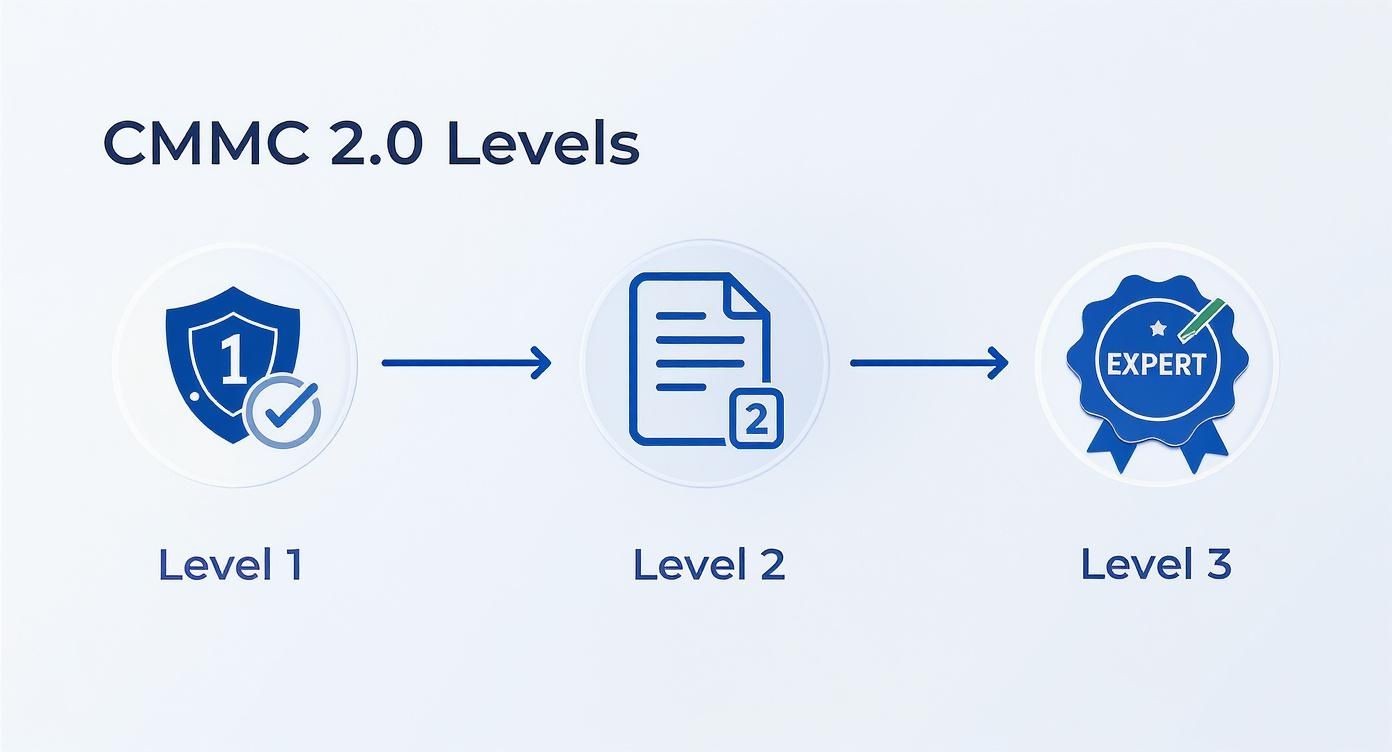
As you can see, each level—Foundational, Advanced, and Expert—demands a higher degree of cybersecurity maturity. Your roadmap will get you there.
Step 1: Define Your Scope
Before you touch a single setting or write a single policy, you have to know exactly what you’re protecting. This is the scoping phase, and it’s where you map out every system, person, and process that comes into contact with FCI and CUI. Getting this right from the start is absolutely critical.
A huge mistake we see is companies defining their scope too broadly. That approach blows up the complexity and cost of the audit for no reason. A much smarter strategy is to use network segmentation to create a secure bubble around the parts of your IT environment that handle CUI. This creates a smaller, more contained "enclave" that becomes the sole focus of your CMMC efforts, simplifying everything.
Your CMMC scope isn't just about servers and firewalls. It includes any employee who accesses CUI, the physical locations where it's stored, and the third-party cloud services you use. A thorough scope is a defensible one.
Step 2: Conduct a Gap Analysis
Okay, you know what’s in scope. Now, where do you stand today? A gap analysis is just a formal way of comparing your current security setup against the specific controls required for your target CMMC level. For most contractors, this means measuring yourself against the 110 controls in NIST SP 800-171.
This analysis will give you a brutally honest look at your strengths and, more importantly, your weaknesses. It's designed to answer a few key questions:
- Which required controls are we already doing well?
- Where are we only partially meeting the requirements?
- Which controls are completely missing?
The result is a clear, actionable list of everything that needs to be fixed before you can even think about calling an assessor.
Step 3: Develop Key Documentation
With your gaps clearly identified, it’s time to get organized. Two documents are the absolute bedrock of any CMMC effort: the System Security Plan (SSP) and the Plan of Action & Milestones (POA&M).
-
System Security Plan (SSP): This is your master document. It describes how you meet each and every required CMMC control, detailing the policies, procedures, and technologies you have in place. The SSP isn't just a formality; it's the first thing assessors will review to understand your entire security program.
-
Plan of Action & Milestones (POA&M): Think of this as your project plan for fixing the gaps. It lists every deficiency found in your analysis, and for each one, you’ll outline the exact steps to fix it, who is responsible, and a timeline for getting it done.
Step 4: Implement Controls and Gather Evidence
Now it’s time to roll up your sleeves. This is where you execute on your POA&M, closing security gaps and putting the necessary controls in place. This could be anything from configuring new security software to training employees on updated procedures.
As you implement each control, you have to gather evidence at the same time. An assessor won't just take your word for it—they need to see proof. This evidence might look like:
- Screenshots of system configurations
- Signed policy and procedure documents
- Security logs from firewalls or antivirus software
- Employee training completion records
Organizing this evidence as you go is a game-changer. When the assessor asks for proof that you’re managing access controls properly, you want to be able to pull up the relevant files instantly. As you build out your CMMC roadmap, integrating top compliance management solutions can make this process far less painful and keep you on track.
Ultimately, this methodical approach ensures you're not just ready for an audit, but are genuinely protecting sensitive defense information. Expert guidance can make this journey much smoother; we offer a range of CMMC readiness and managed security solutions to support your compliance efforts.
The CMMC Assessment and Certification Process
After months of hard work getting your policies, procedures, and security tools in place, it’s time to prove it. The CMMC assessment is where the rubber meets the road—the official verification that turns all your compliance efforts into a formal certification. This isn't just a final exam; think of it more like a home inspection before you sell.
You’ve done the work to fix the roof and update the wiring, and now an independent expert comes in to verify that everything is actually up to code. That independent verification is the cornerstone of trust in the CMMC framework. It’s what ensures every single company in the defense supply chain meets a consistent, reliable security standard.
The entire assessment and certification ecosystem is managed by the Cyber AB (The Cybersecurity Accreditation Body). They are the sole organization authorized by the DoD to accredit the assessors and oversee the whole process, making sure assessments are conducted fairly and consistently across the board.
Key Players in Your CMMC Journey
Navigating a CMMC assessment is much easier when you understand who does what. It's a team effort, and knowing the roles of each player is critical for a smooth process.
- Your Organization: You're in the driver's seat. Your team is responsible for implementing all the required security controls, gathering the evidence to prove it, and working directly with the auditors.
- CMMC Third-Party Assessment Organizations (C3PAOs): These are the independent firms accredited by the Cyber AB to conduct the actual CMMC audits. You’ll need to select and hire a C3PAO to perform your official assessment.
- The Cyber AB: Think of them as the governing body. They accredit the C3PAOs, manage the final certification process, and are the ultimate authority on CMMC standards and procedures.
Navigating the Assessment Stages
The path from hiring an assessor to getting your certificate in hand follows a clear, predictable structure. Knowing these stages ahead of time demystifies the process and helps you prepare much more effectively.
-
Engage a C3PAO: Your first official step is to find and sign a contract with an accredited C3PAO. It’s a good idea to find one with experience in your specific industry and with companies your size.
-
Assessment Planning: Once hired, the C3PAO will work with you to plan the audit. This phase involves reviewing the scope of your assessment, digging into your System Security Plan (SSP), and setting a firm schedule for the review.
-
Conducting the Assessment: This is the main event. The C3PAO team will meticulously review your implementation of every single CMMC control. They'll examine your documentation, interview your people, and test your systems to confirm that your controls aren't just policies on a shelf—they're actually working.
-
Reporting and Findings: After the review, the C3PAO issues a report with their findings. If you’ve met all the controls, you’re on the fast track to certification. If they find any gaps, you’ll have a specific timeframe to fix them.
-
Certification: Once any gaps are remediated and the C3PAO confirms your compliance, they submit their final recommendation to the Cyber AB. From there, the Cyber AB issues your official CMMC certification, which remains valid for three years.
The CMMC assessment is not a "gotcha" exercise. It's a verification process. Assessors want to see that you have a mature, functioning security program, not just a perfect one. Honesty and thorough preparation are your greatest assets.
Self-Attestation vs. Third-Party Audits
A huge distinction in the CMMC model is the type of assessment required for each level. This choice directly impacts the cost, time, and level of scrutiny your organization will face.
For CMMC Level 1, companies can perform an annual self-assessment. This means you review your own compliance against the 15 foundational controls and submit your score to the government's Supplier Performance Risk System (SPRS). A senior company official has to formally attest to its accuracy.
It's a different story for CMMC Level 2 and Level 3. These levels demand a formal, rigorous audit conducted by an accredited C3PAO every three years. This independent, third-party validation is what gives the CMMC program its teeth, providing the DoD with high confidence that its sensitive data is truly being protected. This is the core mechanism that shifts the entire defense industry from a system of trust to one of verified security.
Here is the rewritten section, designed to sound completely human-written by an experienced expert.
Common CMMC Mistakes and How to Avoid Them
The road to CMMC certification is littered with predictable traps that can drain your budget, derail your timeline, and even cause a failed assessment. Knowing what these pitfalls are ahead of time is one of the smartest things you can do. Trust me, it’s far cheaper to learn from someone else’s mistakes than to make them all yourself.
The biggest initial stumble I see is when companies treat CMMC like just another IT project. It’s not. Thinking you can just hand this off to the IT department is a recipe for failure. This isn't about passing a one-time audit; it's about fundamentally building a culture of security across the business.
Misinterpreting Control Requirements
One of the most common errors is just reading the title of a CMMC control and thinking, "Yep, we do that." A company might see "control physical access" and assume their keycard system is enough to check the box. An assessor, however, will go much, much deeper.
They’ll want to see your visitor logs. They’ll ask for your procedures for granting new access and, more importantly, for revoking it. They will absolutely verify that the moment an employee is terminated, their access was cut off immediately. Simply having a piece of tech in place means nothing; you have to prove you have a mature, documented process wrapped around it.
How to Avoid This:
- Go Beyond the Title: You need to read the full description and the specific assessment objectives for every single control that applies to your target level.
- Think Like an Auditor: For each control, ask your team, "How are we going to prove to a stranger that this works consistently every single day?"
- Document Everything: Your System Security Plan (SSP) can't just list what you do. It needs to explain how you do it, who is responsible, and how you make sure it's actually getting done.
Defining an Inaccurate Project Scope
Getting the scope wrong is probably the single most expensive mistake you can make in the entire CMMC process. If you can't draw a clear, defensible line around where your CUI is stored, processed, and transmitted, you're heading for one of two bad outcomes. Either you leave sensitive data exposed and fail your audit, or you drag your entire corporate network into scope, making the assessment exponentially more difficult and costly.
I saw this happen firsthand with a manufacturing firm. They failed their Level 2 assessment because of a single legacy server tucked away in a forgotten rack. The engineering team used it for old project files containing CUI. Because it was outside the "secure enclave" they had defined, it lacked the required controls—an automatic failure.
Scoping isn't just about technology; it's about data flow. You must trace the entire lifecycle of CUI from the moment it enters your organization to the moment it leaves, identifying every person, system, and location it touches along the way.
Failing to Produce Sufficient Evidence
When the assessor shows up, your word is worth next to nothing. The C3PAO operates on a simple principle: "show me, don't tell me." You can have the best security tools on the market and beautifully written policies, but you will fail if you can't produce tangible proof that they're working as intended.
This means having months of security logs ready to go. It means providing completed employee training records, signed policy acceptance forms, and screenshots of system configurations. Trying to scramble and gather all this evidence at the last minute is a nightmare waiting to happen.
How to Avoid This:
- Start Collecting Early: The moment you implement a new control, start thinking about how you'll prove it's working and begin gathering that evidence.
- Organize Meticulously: Create a digital folder structure for your evidence, organizing it logically by the CMMC control number. This will make the audit itself go smoothly.
- Conduct Mock Audits: A readiness assessment is the best way to stress-test your documentation. It helps you find all the gaps before the real assessor does.
You Don't Have to Go It Alone on Your CMMC Journey
https://www.youtube.com/embed/yv8DW1f5qMw
Let's be honest: navigating the world of CMMC can feel like a full-time job, especially if you're a small or midsize business without a dedicated compliance department. The technical controls, endless documentation, and the formal assessment process are a heavy lift. The good news? You don't have to tackle this monumental task by yourself.
Bringing in a CMMC expert turns what feels like a regulatory nightmare into a clear, manageable project. Think of a good partner as your guide and translator—they bring the specialized knowledge and resources needed to get you to certification efficiently, saving you headaches and money. This frees up your team to do what they do best: run your business.
Filling the Gaps with Strategic Support
A seasoned CMMC advisor does more than just check boxes; they provide a strategic roadmap to success. The whole process usually kicks off with a readiness assessment. This critical first step gives you an honest look at where you stand today versus where you need to be for your target CMMC level.
From that baseline, an expert partner can help you shore up your defenses in a few key ways:
- Virtual CISO (vCISO) Services: Imagine having executive-level security leadership on your side, but without the six-figure salary. A vCISO helps you build a sound strategy, ensuring your CMMC efforts actually support your business goals.
- Managed Security Services: Let's face it, most businesses don't have the in-house staff to manage complex tools like a Security Information and Event Management (SIEM) system or run continuous vulnerability scans. A managed security service provider (MSSP) handles all of that for you.
- Remediation and Implementation: Once you know where the gaps are, a partner provides the hands-on help to fix them. They can implement the necessary controls and, just as importantly, create the documentation you'll need to prove it to an assessor.
Reaching out for help isn't a weakness; it's a smart business move. It cuts down your risk, fills critical skill gaps, and drastically reduces the time and internal effort needed to get CMMC certified and stay that way.
The Growing Demand for Certified Experts
The need for this kind of specialized help is exploding. In fact, the global market for cybersecurity certifications, including CMMC services, is on track to hit roughly $4.25 billion USD by 2025. This surge is a direct response to rising cyber threats and tougher regulations. You can discover more insights about the cybersecurity certification market to see the data for yourself.
This trend underscores just how much value companies now place on having a validated, provable security posture. For any business in the Defense Industrial Base, working with a trusted local partner is the surest way to meet DoD requirements right the first time. Learn more about why San Antonio businesses trust Defend IT Services for cybersecurity.
Your CMMC Questions, Answered
As you start digging into CMMC, the practical questions about time, money, and responsibility always come up. Let's tackle some of the most common ones we hear from contractors just like you.
How Much Does CMMC Certification Cost?
This is the big one, and the honest answer is: it depends. There’s no flat fee for CMMC certification. The cost really hinges on your company's size, complexity, and where your cybersecurity posture stands today. Think of it like a home inspection—a brand new house needs far less work to pass than a fixer-upper.
For a small business aiming for Level 1 that already has good security habits, you might be looking at $5,000 to $15,000 for preparation and the self-assessment. A mid-sized company targeting Level 2, however, is a different story. The costs for a gap analysis, fixing those gaps, and the official third-party assessment can easily run from $30,000 to over $100,000. That budget covers consulting, new security tools you might need, and the C3PAO audit itself.
How Long Does the CMMC Certification Process Take?
Start early. I can't stress this enough. CMMC compliance is a marathon, not a sprint, and the timeline is almost entirely dictated by your starting point.
- The Prep Work: This is where you'll spend most of your time—anywhere from 3 to 12+ months. This phase is all about defining your scope, finding the gaps, writing your System Security Plan (SSP), and actually implementing the controls.
- The Formal Assessment: The audit by a C3PAO is much quicker, usually taking one to four weeks, depending on how much they need to review.
Given how long the preparation can take, it's wise to give yourself at least a year to get from square one to being fully ready for an audit.
The single biggest mistake we see is companies underestimating how much time it takes to get ready. CMMC isn't a checklist you can cram for; it’s about building a real, sustainable security program. That just doesn't happen overnight.
What Is the Difference Between CMMC and NIST 800-171?
This is a great question and a frequent point of confusion. The relationship is actually pretty simple.
Think of NIST SP 800-171 as the "what." It's the technical playbook—the list of 110 security controls the government requires for protecting Controlled Unclassified Information (CUI).
CMMC is the "how." It's the DoD's framework for verifying that you've actually implemented those NIST controls correctly. CMMC provides the different levels, the assessment process, and the official certification that proves you’ve done the work.
Do My Subcontractors Need CMMC Certification Too?
Yes, they absolutely do. CMMC requirements "flow down" to every single company in the supply chain. If you're a prime contractor, it's your job to make sure any subcontractor handling FCI or CUI for your project meets the CMMC level required for that data.
This isn't just a suggestion—you have to verify their certification status before bringing them on. Ignoring your supply chain's compliance is a massive risk. A security breach at a subcontractor could put your own contract and certification on the line.
Navigating the ins and outs of CMMC can feel overwhelming. Defend IT Services offers the expert guidance and hands-on support your San Antonio business needs to achieve and maintain compliance with confidence. Learn more about our CMMC readiness services.